Showing posts with label universe. Show all posts

Sunday, July 31, 2011

GBC Book Review: Death From the Skies!

I originally found Phil Plait, Ph. D. through the magic of twitter and have been an avid reader of his blog, Bad Astronomy, ever since. Through the science blogging world that I like to pretend I pay attention to, I heard wonderful things about his book ‘Death From the Skies!’ which deals with the science behind the end of the world so I bought the paperback version in January.

Then it sat on my side table for six months. (I like to think that it was collecting lots of protons and electrons which arranged themselves in the form of dust.)

When I finally did get around to reading it (mainly because I still had a month to go before book five of The Song of Ice and Fire series was released *cough*) I loved it. From the very first sentence in which he asserts that the universe is trying to kill you (but don’t take it personally, it’s trying to kill everybody) to his final summation regarding the odds of these events occurring in our lifetime, the book was a complete joy to read.

Trust him, he's a Doctor. Well, he has a Ph. D. He's not that type of Doctor.

While it is very science-y (yes, that is totally a word) and Plait doesn’t shy away from going into a couple of head scratcher theories, the book is clearly written for the layman who has little to no knowledge of astronomy or astrophysics. The theories are laid out in relatively simple English and there is no assumption that you will remember the theory two chapters later (which I really appreciated when I put the book down for two weeks to work on a couple of projects).

The book, while about a very serious subject, is peppered with Plait’s sense of humour. It is not often that I can say a science book made me laugh out loud but this one definitely did. And despite its serious topic, I found the book oddly reassuring regarding the likelihood of meteor impacts and gamma-ray bursts.  (I still feel threatened by the zombie apocalypse but that’s why I’ve taken up running as a pastime.)

I can’t stress how much I enjoyed this book. The only downside is that I now I have questions regarding some of the theories which means that maybe it’s time I finally gave “A Brief History of Time” a go.

Or maybe I’ll warm up with a few simpler science books first.

Monday, December 20, 2010

Hiding a Full Moon With Something Other Than Pants

In case you've been living under a rock this past week (or on the moon *snort*), there's a full lunar eclipse tonight in a little under two hours (at the time of posting). Lunar eclipses are much different than a solar eclipse because a) you can view them with the naked eye and b) they take several hours to complete. There has been a fog cover over Victoria today and I can not see any indication of stars from my apartment at this time, but nonetheless, I will hike to Central High School and park myself out in the field to see if I can see anything. Please, please, please let the clouds be gone!

If the weather cooperates, I should see something like this.

Technically this lunar eclipse doesn't fall on the winter solstice because that happens at 3:38pm tomorrow, but in the grand scheme of things, most of North America will be seeing this eclipse on the 21st so... The last time this happened was 372 years ago. If you plan on raising nerdy offspring--I can't be alone in this plan--this will be something you can tell them about for years to come. Of course, there will be another lunar eclipse in approximately four years time but not on the solstice!

Now, if you'll excuse me, I have to go brew a big batch of hot chocolate!

Sunday, November 7, 2010

GBC Book Review: The Universe in a Mirror

Robert Zimmerman's The Universe in a Mirror: The Saga of the Hubble Space Telescope and Visionaries Who Built It is a look at the minds and politics behind the Hubble Space Telescope written for those of use who are not rocket scientists. It begins with a quick look at how the atmosphere has always been a hindrance in the study of astronomy before moving into how the Hubble came to be.

Again, all photos are property of NASA and their "you can use it as long as you give credit" awesomeness.

I picked this book up as after seeing the Imax: Hubble and hoping to learn some more about the impact that Hubble has had on our understanding of the universe. On that front, I was sorely disappointed as the book skims over Hubble's contributions to our understanding. Truthfully, it's my own fault because the book very clearly states what it's about, I just didn't read it that closely. I did, however, garner a greater understanding of exactly how difficult it was to even get Hubble made in the first place.

I posted this picture before but an explanation is in order. To test the Deep Field Infrared, it was
decided to point Hubble at an 'empty' part of space, one that had no readings on any system ever used.
This is what Hubble was able to show us.

Overall, I enjoyed the book. There were parts I felt like I had to slog through usually when three new people were introduced within a paragraph of each other and I found I had to go back to try and remember who worked where on what with whom. I occasionally found that I was learning more about people's personal lives than I felt I need to for the purpose of the story, but it was also the intent of the author to show how pursuing the dream that would become Hubble destroyed more marriages, careers and lives than we will ever fully understand.

The book takes an incredible amount of data and condenses it into an easy 240 pages (with the afterword which was added to the paperback) and it was clear that the author had the support of pretty much everyone he was writing about as the majority of the non-universe pictures are listed as 'from the personal collection of...'. Zimmerman does a great job of showing the number of people who were instrumental but also at showing their own flaws and limitations. These were ordinary humans after all trying to do what many in their own field of study thought was impossible. He was also very good at showing all the errors which led up to the wonky lens being given the okay. It was fascinating to see how it all played out and when it came time for 'second light', I found myself feeling giddy knowing how well it was all going to turn out.

This picture of the Eta Carinae was taken at 'second light', the moment when the scientists would learn
if their plan to correct the flawed lens worked. Astronomers had know for hundreds of years that
Eta Carinae was dying. What they didn't know was why it didn't appear to respond like a regular Supernova.
This picture answered what 300 years of study could not.

If you have an interest in astronomy or the Hubble, this is a great book to read. In the end, it made me both laugh and cry which is not an easy feat for a science book. In the words of John Bahcall, one of the lead scientists, "[w]e all have a deep desire to know what exists out there. A desire so basic, so beautiful, so much fun, that it unites all mankind." This book is a fantastic 'thank you' to everyone who made it possible.

Wednesday, September 29, 2010

The Universe Has a Sense of Humour

I wasn't going to blog tonight because I was too busy enjoying my last few hours with my dear friend, Carolyn, (yes, this Carolyn) before she buggers off to Vancouver so that the boy no longer has to be a commuter but then I checked my news feed before going to bed.

Recently I stated in a blog post that I believe there are other planets out there like earth, but I doubt we will find them because "[i]t's the proverbial needle in the haystack except the haystack is the size of the Pacific Ocean."

Tonight's news feed which prompted me to post this? Scientists confirm they have found a Goldilocks planet.

Touché, Universe. Touché.

Tuesday, September 21, 2010

Jupiter's in the Full Moon of Uranus?

I was supposed to write an entry tonight, to be posted tomorrow morning, for the next question in the Great Book Challenge. Instead, I decided to go outside and check out Jupiter in the night sky. On September 20th, Jupiter was the closest it has been to earth since 1963. Today, the 22nd, is the opposition of Jupiter which means we are directly between Jupiter and the sun. In essence, the light reflected back to us is a full Jupiter (next to a full moon, that's pretty awesome).

Dudes. I'm using NASA photos... again.

I, sadly, only had my slightly-wonky-but-correct-with-glasses eyes with which to see this. If you happen to have binoculars (or better yet, a telescope, but if you have that, you probably don't need me to tell you this), you will also be able to see Uranus and a few of Jupiter's moons.

You will still be able to see this for the next few weeks although the brightness will diminish with time so I'd encourage you to get out sooner rather than later.

Saturday, September 18, 2010

My Love Letter to the Universe

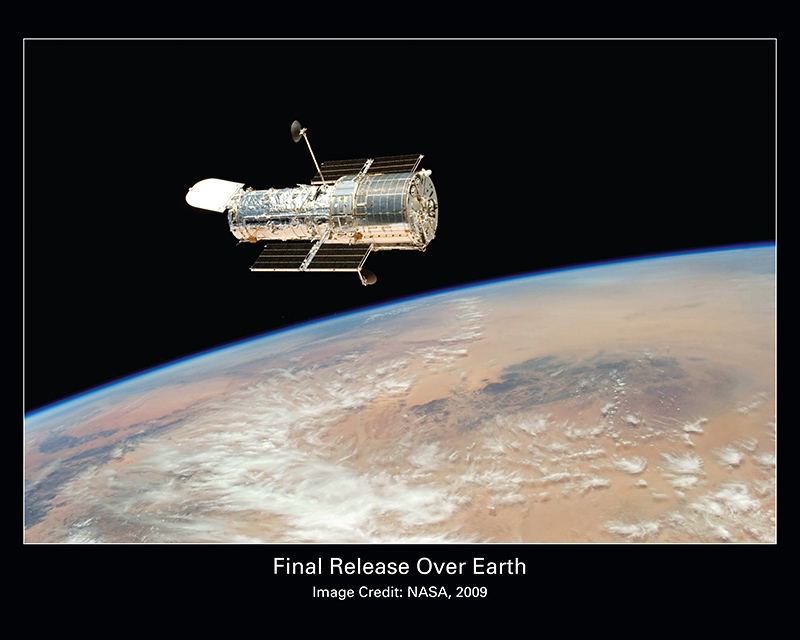
Thanks to two free passes to the Imax that I won last May, I went to Hubble with my friend, Dani, and her son, Liam, this afternoon. I chose the movie because I've always had a passing interest in space and am always captivated when I see Hubble images but I actually didn't know that much about Hubble except that it was a huge telescope orbiting the earth, it was broken almost immediately upon being put into service, it has made huge contributions to our understanding of the universe, and it takes pretty pictures. (Speaking of pictures, NASA does the awesome thing of allowing anyone to use their photos as long as you state 'Dude, these belong to NASA'. You guys rock!)


I came out of the film finally understanding more about what the images I had seen previously actually meant and exactly how large of an impact the Hubble Space Telescope had on our understanding of the universe. It was incredible and amazing and awe-inspiring and humbling. Not wanting to spend any money, I flipped longingly through the coffee table books on display in the gift shop before I came home and did what any self-proclaimed geek would do, I took to the Internet to learn more. I have spent my Friday night reading about nebulae, star clusters, galaxies, supernovas, and more. Let me repeat what I have oft said before: I am a dork.


The Hubble Space Telescope (HST) was named after Edwin Hubble who was able to prove that there were galaxies beyond our own Milky Way. (He also gave us the Big Bang Theory which indirectly gave us an awesome TV show, am I right?) Until his discovery, the belief in astronomy was that we were the only galaxy in the universe. As you can see from the picture above, that is clearly not the case!


HST has allowed astronomers to determine more precisely the rate at which the universe is expanding and, by extension, a better idea of how old it is. It has captured detailed pictures of stars being created and of galaxies in various states of growth. I watched the film and I felt myself fill with that six year old wonderment at it all. The movie ended and my six year old self wanted them to play it again. "Again! Again," she shouted as my 30 year old self put on my jacket and headed towards the door.


My stepdad had the most wonderful knowledge of the natural world growing up. He's a geologist so knowledge of the history of the earth was to be expected, but his ability to look into the night sky and find constellations when we were camping always amazed me. Even more amazing, he tell me their names in Latin and then spew off facts about what the Romans or the Greeks or another ancient civilisation thought about it inevitably coming to the sentence 'of course, modern science now knows...' and then telling me exactly what modern science now knows. I wish I had seen the movie with him so I could have picked his brain on our way out.


Throughout the movie, the soundtrack kept playing refrains from IZ's Somewhere Over the Rainbow and I found myself contemplating exactly how lucky we are for earth to exist. What a lucky chance that a planet formed which is capable of sustaining life. I believe that, given the vastness of the universe and the sheer number of galaxies, there must be other planets out there like earth but I doubt if we'll ever find them. It's the proverbial needle in the haystack except the haystack is the size of the Pacific Ocean. Hmm, maybe we should call the Mythbusters.

It think it's safe to say that a spark went off in me while I watch the movie and I have a burning desire to learn more (which may show up via the the Great Book Challenge) and I may some how find my way back to the gift shop to peruse the Hubble books again, but for now, I'll leave you with the internal soundtrack I was hearing during the movie.

EDIT: Once again, can't get the embedding to work on this blog (but it does on the other one, why not here?) so you can see the video here.